

Swifts
This term…
|
|
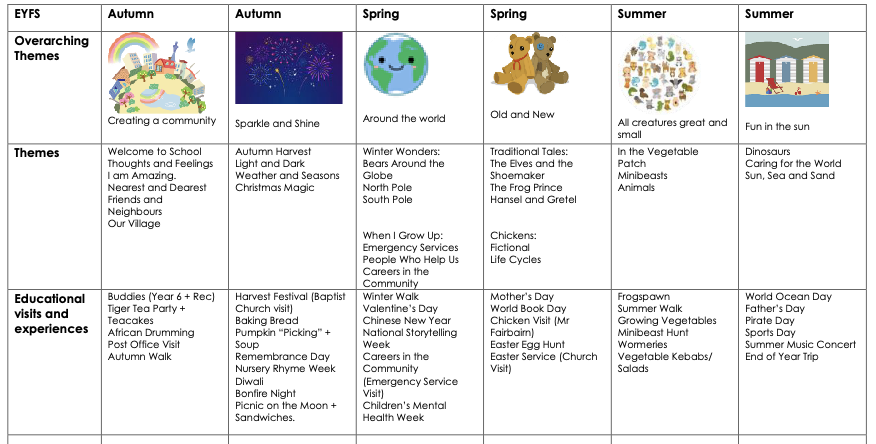
Each half-term we will look at 3-6 topics, all under the ‘umbrella’ of a more general theme. Each topic will last 1-2 weeks, but this is subject to change depending on the time of year or whether the children are particularly enthusiastic about extending their learning within a specific subject. (My previous class were mad about bugs and would happily have studied insects until the end of term). These topics will centre on our sounds and numbers of the week, as well as having a book focus. This half-term our theme is Creating a Community. During the first week at school we started the year with Welcome to School with stories such as “Billy and the Big New School”, settling into our new classroom and identifying our school rules and establishing the class routines. Thank you to all of the parents for already supporting your children so fantastically. I have thoroughly enjoyed getting to know all of the members in Hundred-Acre Wood, and I am very excited for the year ahead! Next, we moved swiftly onto I am Amazing, I Feel Fine with stories such as “Something Else”, “Huge Bag of Worries” and “Billy and the Big New School”; prompting us to explore our thoughts and feelings, and discuss any initial ‘big school’ worries. After that delved into Those Nearest and Dearest with stories such as “The Jolly Postman”, “The Tiger Who Came to Tea” and “When Grandma Came to Stay”; encouraging us to take a closer look at our family and friends, and why they are so important. After half-term we start thinking about the changes in the year with Sparkle and Shine, looking at lots of non-fiction books surrounding Autumn, including a close look at Diwali, in addition to “Kites” and “Umbrella” as we look more closely at Weather and Seasons. A cooking session is also on the cards as we read a historical favourite “Pumpkin Soup”- perfect for a cold and blustery day. Shortly after that we will look at a variety of festivals in, including Bonfire Night and Diwali; Light and Dark is a topic that creates opportunities to investigate opposites and get experimenting. During this time, we will explore stories such as “Owl Babies” and “Whatever Next”, giving us the chance to explore nocturnal animals. Finally, finishing off the calendar year with Festive Favourites as we draw the first term to a close with an exploration of the Christmas story, as well as Miss Moore’s favourite- “The Polar Express”, throwing ourselves into many Christmas activities (here comes the glitter!). In PE, we are lucky enough to have Coach Josh with us during our sessions on a Thursday morning. Please ensure children come to school in their PE kits on Thursdays. |
|
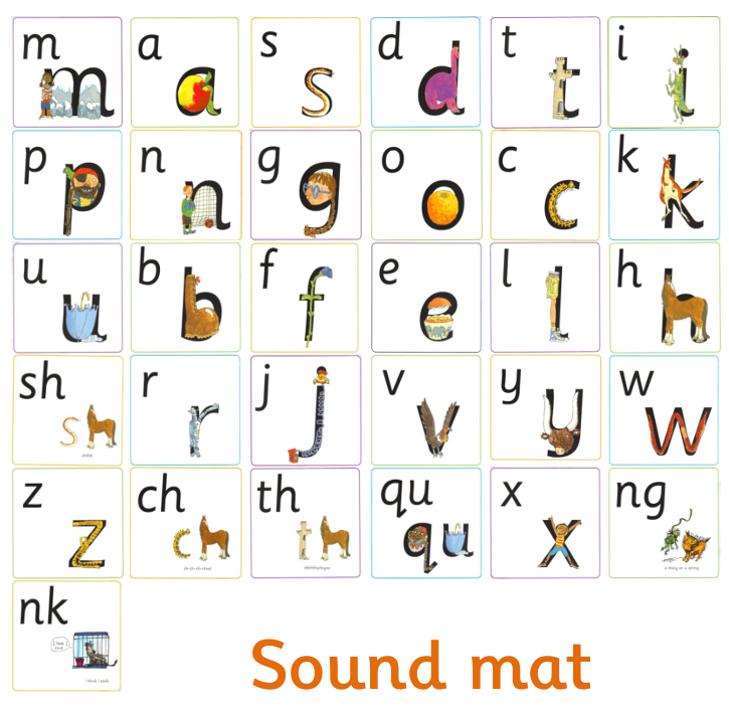
In RE, we use the Emmanuel Project scheme of learning. Our unit is creation within Christianity. We will be learning and reflecting on the question “Why is the word ‘God’ so important to Christians?”; thinking about what the term “God” means to Christians, and the significance of names within our own lives. All of our topics within RE are linked to another faith. This half-term we will briefly look at “A Muslim Whispering Allah in a Baby’s Ear”. Next half-term our question is “Why do Christians Perform Nativity Plays at Christmas?” with the hope that we will partake in our own Nativity as the festive season approaches. Our Muslim story for this second half-term is “Muhammad and the Ants”. By the end of term, the children will have been working on numbers 1 to 5, using our maths scheme White Rose, as well as the initial Set 1 sounds, using our phonics scheme Read Write Inc. |
How you can help at home…
- Continue all that you have been doing!
- Encourage your child to use their imagination – to make up story based games with their toys, to pretend, to dress up, to paint and draw etc.
- Encourage your child to play physically – to run, ride a bike, climb, swing, catch etc.
- Encourage your child to read signs, symbols and labels.
- Share books regularly with your child.
- Help your child to learn to go to the toilet independently, and to wash and dry their hands.
- Play counting games with your child.
- Encourage your child to experiment with reading and writing their own name.
- Encourage your child to do things independently – e.g. getting dressed, tidying things away etc.
- Show a real interest in your child’s learning at school- talk to them about their day.
- Give your child some quiet time to reflect positively on their day.
- Ensure your child has as much sleep as they need – school can be a tiring place!
- Encourage your child to make friends at school – invite other children round to play.
- Continue to talk about school positively and enthusiastically.
The children will be assessed on their phonological awareness over the year and, when ready, given sounds, words and texts to complement their reading ability. This should be read as independently as possible, but should be read out loud to an adult who is able to support if necessary. These should be practiced at least twice, once for sound/ word recognition and once for comprehension.
Reading is of vital importance, if your child is confident enough to begin reading simple stories then please support and encourage this as regularly as possible both with school books and home books.
There are still so many benefits to sharing stories; read to your child, whenever and wherever you can. I am happy for children to borrow books from school, as long as they are taken good care of. Start thinking about how to incorporate reading into your everyday life; reading road signs, cooking instructions, shopping lists or even subtitles on their favourite TV show.
Below are a list of books that will fit nicely with the theme of this half-term if you are interested:
|
Title |
Author/ Illustrator |
|
Alphabet Ice-Cream |
Nick Sharratt and Sue Heap |
|
The Lion Inside |
Rachel Bright and Jim Field |
|
ABC Animal Rhymes for You and Me |
Giles Andreae and David Wojtowycz |
|
Billy and the Big New School |
Laurence Anholt and Catherine Anholt |
|
It’s Not Always Easy To Share |
Susan Polis Schutz |
|
The Great Big Book of Feeling |
Mary Hoffman and Ros Aquith |
|
This Moose Belongs to Me |
Oliver Jeffers |
|
The Koala Who Could |
Rachel Bright and Jim Field |
|
Too Shy for Show and Tell |
Beth Bracken |
|
Something Else |
Kathryn Cave and Chris Riddell |
|
Come to School Too Blue Kangaroo |
Emma Chichester Clark |
|
I’m Feeling Angry |
Lisa Regan |
|
Penguins Can’t Fly |
Katherine Sully |
|
Grandma Comes to Stay |
Ifeoma Onyefulu |
|
The New Small Person |
Lauren Child |
|
Boris Starts School |
Carrie Weston and Tim Warnes |
|
Dealing with Feelings- Caring |
Isabel Thomas |
|
Jamela’s Dress |
Nick Daly |
Remember…
Water bottles need to be taken home daily for cleaning and refilling. This should be filled with water only please.
It is important to ensure everything is clearly named.
Please ensure your child comes into school in their named PE kit on Thursdays.
For those hotter days, please ensure that you child is wearing sun-cream and has a hat.
For those cold and rainy days please ensure that your child has a coat to wear.
Thank you for your support.
The Early Years Foundation Stage (EYFS) is the ‘curriculum’ of the Reception year. The EYFS framework sets out key learning goals for your child’s early development which, if achieved, provide the 'foundations' for all later learning and successes, focusing on developing every child's skills through, playing and exploring, active learning, creating and thinking critically through 7 areas of learning and development:
The 3 Prime Areas of the EYFS are:
- Communication and language
- Physical development
- Personal, social and emotional development.
The 4 Specific Areas of the EYFS are:
- Literacy
- Mathematics
- Understanding the world
- Expressive arts and design
We help our Reception children to work towards the Early Learning Goals which are the Knowledge, Skills and Understanding children should have at the end of their first academic year at school. Our work involves ongoing assessment and reporting to parents and/or carers as well as considering our children’s Safeguarding and Welfare Requirements.
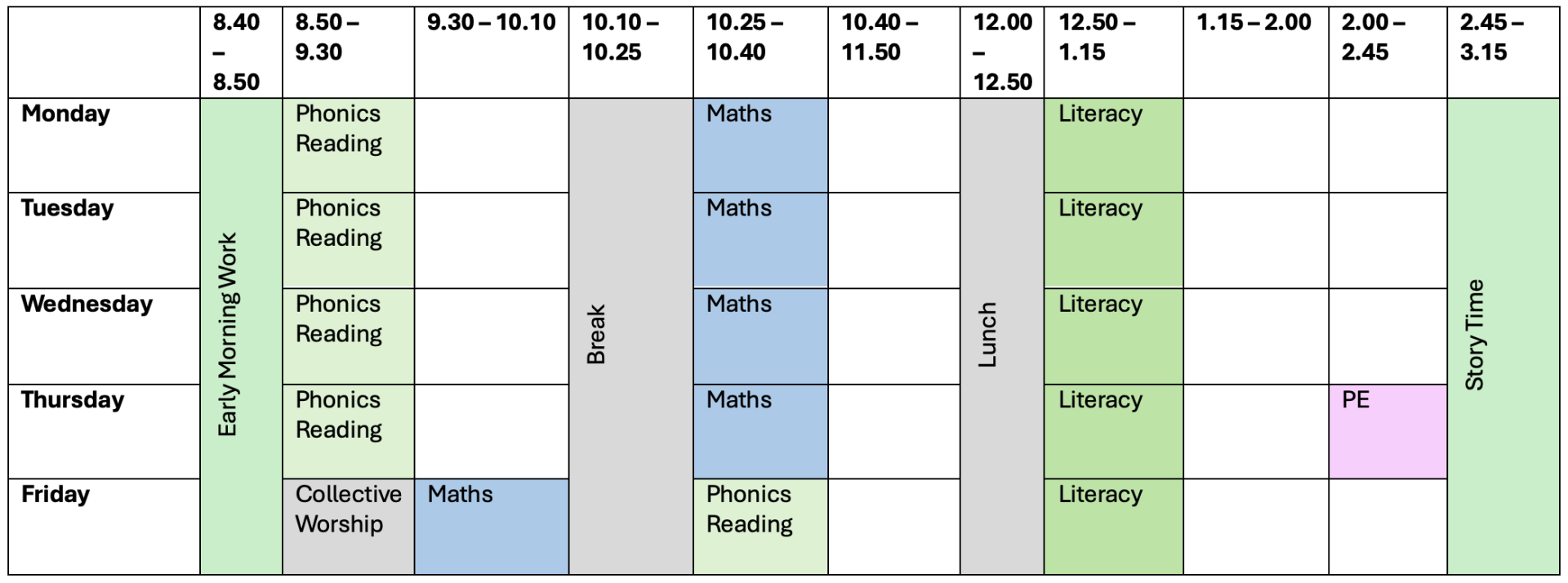
A copy of our timetable is below, but it will evolve as we move through the year and may change from time to time.
reception maths booklet 2023.pdf