


Our Science scheme of work aims to inspire pupils to become curious, inquisitive and analytical thinkers with a broad understanding of the natural world – in other words, to think like scientists. The intention is for pupils to develop the confidence to ask questions, make observations, carry out investigations, record data in a variety of ways and analyse and present their findings.
The scheme aims to build an awareness of how science influences everyday life and drives progress in society. The hope is to encourage pupils to become reflective, responsible individuals who use scientific knowledge and skills to make informed decisions and contribute positively to the world around them.
The scheme supports teachers in developing their subject knowledge and skills, enabling the delivery of engaging, well-informed lessons with confidence. The curriculum is designed to be both accessible and ambitious, ensuring all learners’ full participation and potential achievement.
The National curriculum for Science sets out the importance of developing scientific knowledge and conceptual understanding across the disciplines of biology, chemistry and physics. It also emphasises the role of scientific enquiry in helping pupils understand the nature and methods of science.
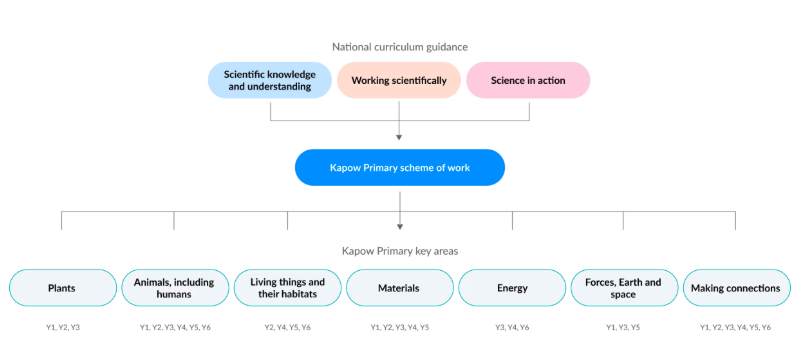
To support this, Kapow Primary’s Science curriculum is organised into the following seven key areas:
• Plants
• Animals, including humans
• Living things and their habitats
• Materials
• Energy
• Forces, Earth and space
• Making connections
These areas are revisited across year groups to ensure that pupils build a secure and connected understanding of key scientific concepts while developing their ability to think and work scientifically.
Based on the National curriculum, the following three strands have been identified, which run throughout the Science curriculum:
- Scientific knowledge and understanding.
- Working scientifically.
- Science in action.
The Science curriculum has been planned with these strands running through each unit, ensuring balanced coverage of the different areas of Science and both substantive and disciplinary knowledge.
SMSC
The Science scheme supports Spiritual, Moral, Social and Cultural (SMSC) development by encouraging pupils to:
- Explore different perspectives.
- Reflect on ethical issues.
- Collaborate with others.
- Appreciate cultural diversity through subject-specific content.
British values
Lessons promote British values (democracy, the rule of law, individual liberty, mutual respect and tolerance) by incorporating activities that encourage debate, respect for differing opinions and an understanding of societal structures.
Cultural capital
Our Science curriculum broadens children’s experiences by introducing them to key scientists, significant discoveries and diverse scientific contexts.
The scheme helps ensure they gain the knowledge and skills needed to understand the world around them and engage meaningfully with science in everyday life.
Our Science scheme of work is designed to be fully adaptable for pupils with SEND. Every lesson includes an adaptive teaching section, providing clear guidance on how activities can be modified to meet the needs of all learners.
Children learn in various ways. As such, lessons include a range of strategies to support and challenge every pupil, such as:
Scaffolding – activities are designed with flexibility in mind, allowing for additional support or challenge where needed.
Multi-sensory approaches – lessons incorporate different elements to engage all learners.
Clear instructions and structured tasks – ensuring clarity and reducing cognitive load for pupils who benefit from additional support.
Opportunities for collaborative and independent learning – allowing pupils to work at their own pace while building confidence and independence.
By embedding adaptive teaching throughout, the scheme ensures that all pupils, regardless of their starting points, can access and succeed in their learning.
In addition, the step-by-step curriculum design supports pupils with SEND, avoiding sudden jumps in complexity at transition points and allowing for steady, manageable progression.
Coverage Map
science curriculum overview.pdf
Progression Map
skills and knowledge document.pdf